
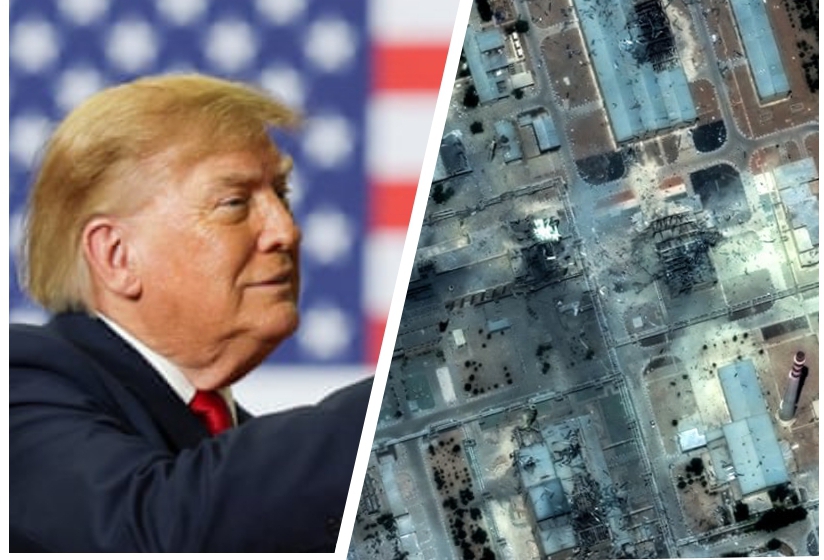
Collage photo of American President, Donald Trump and debris of military sites destroyed in Iran by American missiles.
By Anietie Akpan – Nigeria
Regional wars, nuclear rivalry and threats to international shipping are creating dangerous routes to a wider global conflict. Yet, peace and conflict scholars are drawing themselves back from admitting that Word War lll has quietly begun, arguing that the available evidence does not justify declaring that a third world war has already begun.
A world war is an extensive, interconnected armed conflict involving several major powers and their partners across multiple regions, with consequences for the wider international order. However, scholars do not offer one universally accepted definition or numerical threshold. Understanding the concept requires distinguishing the nature of war from the geographical reach, participation and systemic consequences that make a war global.

Four international scholars— Carl von Clausewitz, Hedley Bull, Jack S. Levy and Robert Gilpin— and Nigerian scholar Bolaji Akinyemi provide useful perspectives. Their arguments below are paraphrased; they should not all be read as formal definitions of “world war”.
Prussian military theorist, Carl von Clausewitz conceptualised war as the use of violence to compel an opponent to submit to one’s will. His analysis also connects military action to political purposes: governments employ force to pursue objectives, although uncertainty, resistance, and the dynamics of fighting can frustrate their intentions. Applied to the present question, Clausewitz’s perspective directs attention to actual organised violence and political objectives. Hostile speeches, economic rivalry, and diplomatic disagreement can create conditions for war, but they are not, by themselves, sufficient evidence that a world war exists (Clausewitz, 1832/1873).
The Australian international relations scholar Hedley Bull understood war as organised violence conducted by political units against one another. Importantly, he distinguished actual hostilities from a legally recognised or formally declared state of war. Fighting can occur even when governments describe it using another term. Bull’s approach therefore cautions against waiting for leaders to announce “World War III” before examining whether a global conflict exists. The assessment must rest on the character of the violence, its participants and its connections across theatres (Bull, 1977).
The American political scientist Jack S. Levy examined warfare through the historical development of the great-power system. His study systematically identifies major powers and their international wars over several centuries. This approach matters because the participation and interaction of powerful states deserve particular attention when assessing the scale of a conflict. However, a war involving one great power does not automatically become a world war. The broader configuration of opponents, partners and interconnected fighting remains essential to the assessment (Levy, 1983).
The American international political economy scholar Robert Gilpin developed the concept of hegemonic war: a major struggle associated with changes in the distribution of power and capable of transforming the international system. His argument helps explain why some wars carry consequences beyond their immediate territorial disputes. They may concern the hierarchy of states and the rules governing international relations. Nevertheless, hegemonic war and world war are not interchangeable terms, and power transitions do not make military conflict inevitable (Gilpin, 1988).
From Nigeria, Professor Bolaji Akinyemi, an international relations scholar and former Minister of External Affairs, has emphasised the danger of regional wars becoming direct confrontations between superpowers. In an interview reproduced on his professional website, he distinguished limited conflicts from the prospect of major powers fighting one another directly. His comments provide an escalation perspective rather than a formal academic definition of world war. In a separate interview, he warned that Nigeria must consider the international economic consequences of the Russia–Ukraine conflict (Akinyemi, 2026; Channels Television, 2025).
In essence, these perspectives support the working definition used in this article: a world war would involve sustained, interconnected warfare among several major powers and their partners across multiple regions, with extensive international mobilisation and consequences for the global order. This is an analytical synthesis, not a definition attributed verbatim to any one scholar.
A dangerous world, but an important distinction
The fear of another world war is understandable. Russia’s war against Ukraine continues; the Middle East has experienced direct military confrontation involving the United States, Israel and Iran, alongside threats to regional infrastructure and navigation; and tensions around Taiwan remain unresolved. These developments create several possible routes to a wider conflict (Reuters, 15 October 2026; Council of the European Union, 2026).
Nevertheless, the reporting reviewed for this article does not establish that these conflicts have merged into one sustained global war among opposing coalitions of major powers. That is an assessment of the available evidence, rather than a guarantee about future events.
A conflict can have worldwide economic consequences without becoming a world war. Rising freight costs, disrupted energy supplies or financial uncertainty demonstrate international exposure to violence. They do not necessarily establish direct participation in the same war.
The distinction also matters morally. Avoiding the premature label “world war” does not diminish the suffering of people already experiencing bombardment, displacement, hunger and bereavement. Existing wars require urgent action regardless of what historians eventually call this period.
Ukraine: The danger of a wider European confrontation
Ukraine remains a central test of whether a major interstate war can be prevented from expanding into sustained confrontation between Russia and NATO members.
On 14 October, Reuters reported that Russian strikes killed civilians and damaged Ukrainian energy facilities, according to Ukrainian authorities. Such attacks illustrate the continuing human and infrastructural costs of the war (Reuters, 14 October 2026a).
The wider escalation risk concerns incidents that could bring Russian and NATO forces into direct combat. These might include an attack on alliance territory, a confrontation involving military aircraft, or an incident whose responsibility and intention are initially uncertain. These are possible scenarios, not claims that such a wider war has already begun.
One danger is political pressure following an incident. Leaders may fear that restraint will be interpreted as weakness, while their opponents may interpret defensive preparations as preparations for attack. Decisions intended to restore deterrence can consequently produce another round of escalation.
NATO’s Article 5 must therefore be explained accurately. It treats an armed attack against one member as an attack against all, but each ally determines the assistance it considers necessary. That assistance can include military force, but it does not require every member to undertake an identical armed response (NATO, 2025).
This provision leaves space for consultation and calibrated action. It also makes accurate attribution and political judgement crucial.
Diplomatic possibilities remain. On 19 October, Reuters reported plans for further American engagement with Ukrainian, European and Russian interlocutors, while noting that arrangements were tentative. Such reporting establishes diplomatic activity, not the certainty of a settlement (Reuters, 19 October 2026).
Durable negotiations would need to address security, territory, implementation and the participation of the people whose country is at war. An announcement alone cannot resolve those questions.
The Middle East: Regional warfare with global consequences
The Middle East presents another serious route to wider conflict because military operations intersect with energy infrastructure, international shipping and external security commitments.
A Reuters investigation published on 15 October described Iranian and allied attacks on Gulf infrastructure following the American and Israeli bombing campaign that began on 28 February 2026. The investigation highlighted the vulnerability of energy and transport networks to attacks with consequences extending beyond the immediate target (Reuters, 15 October 2026).
In its conclusions of 15–16 October, the European Council condemned Iranian attacks against countries in the region and actions threatening navigation through the Strait of Hormuz. These statements are the European Union’s official position and should be understood as such (Council of the European Union, 2026).
The escalation mechanism is straightforward. An attack on shipping may produce naval protection operations. A confrontation involving those forces may lead to retaliation. Retaliation may expand the geographical area of operations and pressure additional governments to intervene.
These outcomes are not automatic. They depend on political decisions, military conduct and whether channels for containing incidents remain effective.
The humanitarian consequences also extend beyond petroleum. Reuters reported on 14 October that a United Nations official warned of food-security risks in parts of Africa and Asia if arrangements to facilitate fertiliser movements through Hormuz were not activated promptly (Reuters, 14 October 2026b).
This illustrates how an overseas maritime crisis can affect agricultural production and household welfare far from the battlefield. Its international reach is clear; classifying it as part of a world war still requires separate assessment.
Taiwan: Pressure, signalling and the risk of miscalculation
Taiwan remains a potential flashpoint because competing sovereignty claims intersect with military deployments, American support for Taiwan and the security interests of neighbouring states.
The latest reporting reviewed here, published by Reuters on 20 October, described criticism by a US congressionally appointed commission chair of Chinese coast guard patrols east of Taiwan. The report also attributed to Taiwanese officials their concern that Beijing could be practicing elements of a maritime blockade. Those statements are assessments by identified officials, not independent proof that a blockade or invasion has been ordered (Reuters, 20 October 2026).
The danger includes action short of an amphibious invasion. A blockade, coercive inspection regime or serious confrontation at sea could force difficult decisions about intervention and escalation.
Military exercises also require careful interpretation. Reuters reported on 12 October that Taiwan was monitoring Chinese live-fire drills along China’s coastline and distinguished those activities from exercises taking place directly around Taiwan (Reuters, 12 October 2026).
Such distinctions help prevent ordinary military reporting from becoming an unsupported prediction of imminent war.
A Taiwan crisis would become especially dangerous if it occurred alongside confrontation in Europe or the Middle East. Diplomatic attention could be divided, military resources stretched, and separate developments interpreted as coordinated hostile action.
That is a plausible escalation pathway. It is not evidence that governments have already committed themselves to such a global conflict.
Nuclear weapons raise the consequences of error
Nuclear weapons make the possibility of major-power warfare particularly alarming.
The Stockholm International Peace Research Institute’s June assessment warned that states were relying more heavily on nuclear weapons while risks of miscalculation and escalation were increasing. SIPRI estimated approximately 12,187 nuclear warheads worldwide in January 2026, including about 4,012 deployed warheads. SIPRI estimated that between 2,100 and 2,200 deployed warheads were maintained on high operational alert (SIPRI, 2026).
These are research estimates, not a complete independently verified inventory of every weapon. Nuclear deterrence can discourage attack by making the expected consequences unacceptable. However, it also depends on reliable information, functioning communications and the ability to interpret an opponent’s behaviour.
A conventional strike could be misread as preparation for a larger offensive. Disruption of command systems could create fears that a state was losing its ability to respond. Under intense pressure, leaders might act before uncertain information had been adequately checked.
These risks do not mean nuclear use is inevitable. It means that systems for preventing error deserve as much attention as declarations of military resolve.
In his September message for the International Day for the Total Elimination of Nuclear Weapons, UN Secretary-General António Guterres warned of increasing nuclear danger and called for renewed dialogue and disarmament (United Nations, 2026).
World war and nuclear war must also remain conceptually distinct. A global war could initially be conventional. Nuclear use in a regional conflict would be a catastrophe, but its further expansion would still depend on subsequent decisions.
Cyberattacks, sabotage and the problem of attribution
International confrontation increasingly includes cyber operations, espionage, sabotage and attempts to influence public opinion.
On 13 October, Reuters reported warnings by Britain’s domestic intelligence chief about intensified Iranian and Russian campaigns against British interests. The report also recorded denials by the accused states. These were attributed security assessments and allegations, not grounds to treat every reported incident as conclusively established (Reuters, 13 October 2026).
Such operations complicate escalation management because responsibility may be uncertain and state involvement disputed.
The danger grows when governments feel compelled to respond before assessing evidence. A cyber disruption could be interpreted as the opening stage of a military offensive even if its cause or purpose remained unclear.
Nevertheless, espionage, cyber intrusion, economic sanctions and armed attacks are not interchangeable. Their seriousness must be assessed individually. Calling every hostile activity an act of war weakens the distinctions needed for proportionate responses.
Are today’s conflicts merging?
The strongest argument for heightened concern is that crises can interact.
Energy disruption in one region can alter diplomatic calculations in another. Governments can exchange military technology, coordinate political positions or exploit an opponent’s divided attention. Economic measures can also connect conflicts through trade, finance and access to strategic resources.
However, interaction does not necessarily mean integration into one war. States that cooperate on some issues may have different priorities, different risk tolerances, and different reasons to avoid direct combat.
Gilpin’s analysis helps explain why rivalry over the international order matters. It does not permit the conclusion that every dispute involving powerful states is one coordinated struggle, or that power competition must culminate in global war (Gilpin, 1988).
The essential task is to trace actual connections and decisions rather than assume a single hidden command behind multiple crises.
Africa’s wars must remain visible
Discussion of World War III often concentrates on Washington, Moscow, Beijing and the Middle East. That emphasis can obscure conflicts whose civilian consequences are already devastating.
United Nations reporting on Sudan describes continuing attacks, displacement and severe disruption of essential services. Its humanitarian coordinator’s statement of 10 October condemned further reported civilian killings and stressed accountability and the protection afforded by international humanitarian law (United Nations in Sudan, 2026).
The importance of these wars does not depend on whether they involve direct fighting between superpowers. Civilians need protection, humanitarian access and political efforts to end violence now.
African diplomacy should therefore address both tasks: preventing wider international escalation and securing sustained attention to conflicts already destroying lives on the continent.
What the situation means for Nigeria
For Nigeria, the implications are economic, diplomatic and domestic. The following are transmission risks and policy considerations, not forecasts that every outcome will occur.
Higher international oil prices can increase potential export receipts when production and sales are sustained. At the same time, more expensive energy, freight and insurance can raise costs for businesses and households. The net effect depends on production performance, refining, exchange-rate conditions and public policy.
Agriculture is another channel. Disrupted fertilizer supplies or higher transport costs could increase production expenses and pressure food prices. The UN-related warning about Hormuz shows this risk matters to countries beyond the Gulf (Reuters, 2026).
Financial uncertainty could also make investors more cautious and external financing more expensive. Manufacturers may face delays or higher costs for machinery and imported inputs. Citizens living abroad may require timely consular assistance if hostilities expand.
Akinyemi’s warning about the economic implications of the Russia–Ukraine war is therefore relevant to Nigerian preparedness, even though his interview predates the latest developments (Channels Television, 2025).
Nigeria should strengthen agricultural productivity, protect critical infrastructure, diversify essential supply arrangements and maintain credible emergency plans for citizens overseas.
Domestic security also matters. External shocks become harder to absorb when insecurity disrupts production, transport and investment at home. Preparedness requires administrative competence and economic resilience as well as security capacity.
Diplomatically, Nigeria should defend civilian protection, sovereignty and international law while supporting credible mediation. Maintaining independent judgment need not mean treating every action by every party as equally justified.
The indicators that deserve close attention
The major indicators of a possible World War III are developments showing that regional conflicts are expanding into sustained, interconnected warfare between major powers. No single warning sign proves that a world war has begun.
Below is an analytical guide to understanding major indicators.
Major indicators, what to watch for and
why it matters.
1. Direct fighting between major powers
Sustained combat between countries such as the United States, Russia or China.
This would represent a major escalation beyond arms supplies, sanctions or diplomatic support.
2. Regional wars becoming interconnected
Fighting in Europe, the Middle East and Asia becoming linked through military operations and strategic decisions.
Separate conflicts could develop into a wider struggle involving the same opposing powers.
3. Alliances entering combat
Several countries joining sustained military operations following an attack on a partner.
A conflict between two states could expand to involve competing coalitions
4. Large-scale military mobilisation
Extensive reserve call-ups, conscription, troop movements and preparations for prolonged warfare across several countries.
These could indicate that governments expect a substantially larger conflict.
5.Significant changes in nuclear readiness
Credibly verified increases in nuclear alert levels or unusual operational deployments.
These can increase the consequences of miscalculation and reduce the time available for decisions.
6. Breakdown of crisis communication
Closure of military hotlines, abandonment of negotiations and refusal to clarify dangerous incidents.
Governments lose opportunities to prevent accidents or misunderstandings from escalating.
7. Attacks on strategic command systems
Attacks affecting military communications, early-warning systems or satellites used for critical military functions.
An opponent could interpret them as preparation for a much larger attack.
8. Widespread attacks on infrastructure and shipping
Sustained attacks across several countries on ports, energy systems, communications and major trade routes.
These could broaden military participation and disrupt essential international supplies.
9. Economies shifting towards prolonged war
Governments are extensively redirecting factories, budgets, transport, and essential supplies toward military needs.
This suggests preparation for a conflict extending beyond a limited campaign.
The strongest indicator is sustained direct warfare among several major powers across connected theatres. Nuclear threats, military exercises, increased defence spending or economic sanctions are concerning in context, but they do not independently establish that World War III is under way.
Two distinctions are particularly important:
An alliance commitment does not automatically produce a world war. NATO explains that Article 5 obliges members to assist an attacked ally, but each determines the action it considers necessary; assistance does not invariably involve armed force.
Nuclear danger is a warning, not a countdown. SIPRI’s 2026 assessment identifies increasing reliance on nuclear weapons and rising risks of miscalculation and escalation. Its research also warns that interactions between conventional, cyber, space and nuclear capabilities can create dangerous misunderstandings.
The practical question is whether several indicators are occurring together, persisting and drawing additional major powers into combat. That pattern would matter more than any isolated threat, exercise, or alarming headline.
Why it would matter: Necessary caution
Sustained direct fighting between major powers It would represent a major escalation beyond indirect assistance or isolated encounters. The duration, scale and participants must be established.
Conflict spreading across linked theatres Separate wars could become mutually reinforcing parts of a wider struggle. Simultaneous crises do not automatically prove coordination.
Broad mobilisation across several countries It could indicate preparation for prolonged warfare. Exercises and precautionary measures require context.
Significant changes in nuclear readiness They could increase pressure on decision-makers and shorten response time. Claims require credible verification.
Closure of crisis communication channels Leaders would have fewer ways to clarify incidents. Diplomatic breakdown does not itself establish war.
Prolonged disruption of major shipping routes Economic damage could increase pressure for intervention. Worldwide economic effects remain distinct from worldwide combat.
Why wider war can still be prevented
Several restraints remain. Major powers recognise that direct warfare could impose enormous losses. Their partners do not necessarily share every strategic objective. Military limitations, economic exposure and uncertainty about outcomes can encourage caution.
Diplomatic channels also remain, as reporting on further Ukraine-related engagement shows. Their value depends on sustained use and realistic expectations.
Prevention requires practical arrangements: functioning crisis hotlines, clear communication about military exercises, procedures to reduce dangerous encounters at sea and in the air, protection of civilian infrastructure and workable humanitarian agreements.
Negotiations should have clear objectives and implementation mechanisms. Where comprehensive settlements are initially impossible, limited agreements can still reduce suffering or contain specific risks.
Such steps do not remove underlying disputes. They can prevent an incident from becoming a larger war while political negotiations continue.
The verdict
As of 20 October 2026, the evidence reviewed does not justify presenting World War III as an established, ongoing global conflict. It does justify serious concern about the possibility of escalation across several dangerous theatres.
The distinction between “could happen” and “has happened” is essential. So is the distinction between warning and prediction.
For Nigeria, the appropriate response combines informed diplomacy, domestic security and economic preparedness. For major powers, the overriding responsibility is to prevent regional wars from becoming sustained direct confrontations among themselves.
The future remains contingent on decisions. That is why restraint, civilian protection and diplomacy remain urgent instruments of security.