
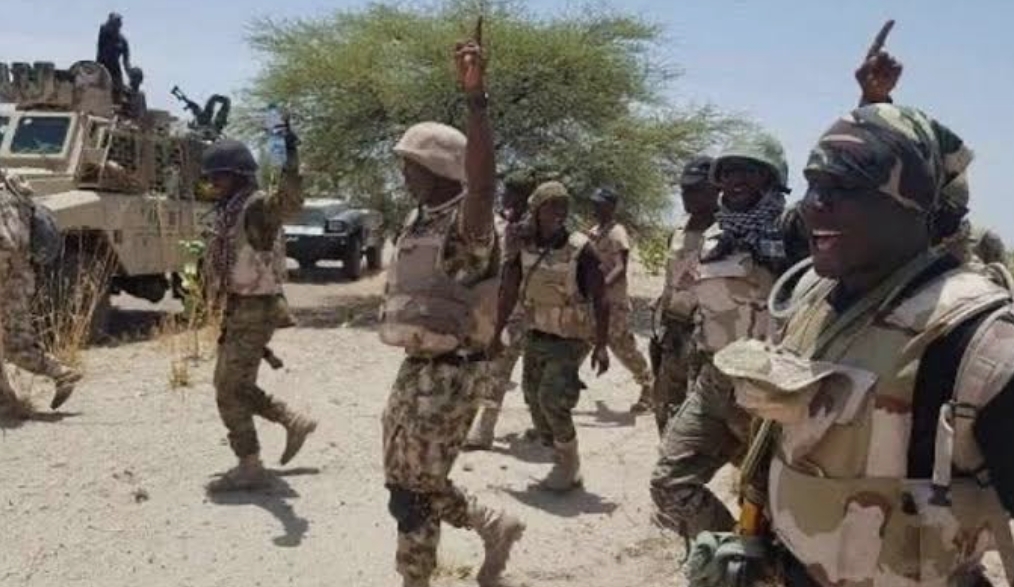
Google image: Troop in theatre of war.
Frank Onyeka
In a decisive continuation of the joint counterterrorism campaign launched earlier in May 2026, combined operational forces of the United States military and the Nigerian Armed Forces carried out another major offensive across parts of Northern Nigeria, leading to the elimination of several high-profile terrorist commanders and the destruction of insurgent logistics networks believed to be connected to regional extremist cells operating within the Lake Chad Basin and the wider Sahel corridor.
The operation, which followed the strategic gains recorded during the coordinated military strikes of 16 May 2026, marked one of the most sophisticated multinational security offensives conducted in West Africa in recent years. Intelligence-driven, technologically advanced, and executed with precision coordination between air and ground components, the latest mission demonstrated the growing evolution of Nigeria’s counterinsurgency architecture and the expanding strategic partnership between the Nigerian military and American defense institutions.

The operation reportedly began several weeks after intelligence analysts attached to joint surveillance units detected renewed movements of insurgent fighters across remote forest corridors linking parts of Borno, Yobe, and northern Adamawa States.
According to security sources familiar with the mission, signals intelligence gathered from drone reconnaissance platforms and satellite monitoring systems revealed unusual communications traffic among suspected terrorist commanders believed to have regrouped after sustaining losses during earlier military bombardments. Analysts reportedly identified clandestine movement patterns involving heavily armed convoys, hidden weapons depots, fuel storage facilities, and temporary training camps concealed deep within difficult terrains bordering the Sambisa forest axis and sections of the Lake Chad region.
American intelligence support played a major role during the preparatory phase of the operation. Surveillance aircraft and advanced reconnaissance drones operating in coordination with Nigerian military intelligence units reportedly tracked insurgent movements continuously for several days. Thermal imaging technologies and electronic interception capabilities enabled analysts to map out command positions, logistical supply channels, and possible escape routes used by the militants. The information was then transmitted to operational headquarters of the Nigerian Armed Forces where strategic planners began developing a synchronised assault framework designed to strike multiple terrorist enclaves simultaneously.
Military officials disclosed that the objective of the operation was not merely to eliminate fighters but to dismantle the insurgents’ operational infrastructure entirely. This included destroying communication hubs, disrupting recruitment networks, intercepting arms movements, neutralising field commanders, and preventing the terrorists from reorganising after the setbacks suffered earlier in the month. Security experts noted that unlike previous operations which focused primarily on direct confrontation, the latest offensive emphasized intelligence dominance, rapid mobility, precision targeting, and inter-force coordination between air, land, and special operations units.
The offensive was reportedly launched during the early hours before dawn when combined aerial reconnaissance confirmed the presence of multiple insurgent concentrations within identified target zones. Nigerian Air Force fighter aircraft supported by American surveillance coordination reportedly initiated the first phase with precision airstrikes targeting suspected command compounds and weapons storage locations. Witnesses from nearby rural communities later described hearing sustained explosions across isolated forest regions followed by prolonged aerial activity throughout the morning hours.
According to operational accounts, the initial bombardment was designed to create confusion within insurgent ranks while preventing organised resistance against advancing ground troops. Moments after the aerial strikes commenced, elite Nigerian special operations forces supported by mechanised infantry columns began advancing toward multiple target locations from different directions.
Troops reportedly encountered pockets of resistance from heavily armed fighters attempting to defend strategic hideouts, but military commanders indicated that the insurgents were overwhelmed by the speed and coordination of the assault.
American military advisers were said to have provided technical operational support, aerial intelligence coordination, and battlefield surveillance throughout the mission, while Nigerian forces led the direct combat engagement on the ground. Security analysts observed that this operational model reflects the broader security cooperation arrangement between both countries whereby the United States contributes advanced technological and intelligence capabilities while Nigeria maintains operational command sovereignty within its territory.
One of the most significant aspects of the operation was the deployment of advanced unmanned aerial systems capable of maintaining persistent surveillance over hostile territories for extended periods. Military sources indicated that drones equipped with infrared tracking systems monitored insurgent movements in real time, allowing commanders to adjust troop deployments instantly as the battle progressed. Whenever militants attempted to retreat through hidden routes or regroup within forest clusters, aerial surveillance systems quickly relayed their coordinates to advancing forces, enabling rapid interception.
Several terrorist commanders were reportedly neutralised during the operation. Although official identities were not immediately disclosed for security reasons, military intelligence sources suggested that among those eliminated were field coordinators responsible for organising attacks against civilian communities, military outposts, and humanitarian convoys in northeastern Nigeria. Intelligence officers also indicated that some of the targeted commanders maintained operational links with transnational extremist factions operating across the Sahel region.
The destruction of logistics infrastructure represented another major breakthrough achieved during the offensive. Troops reportedly uncovered large quantities of assault rifles, machine guns, rocket-propelled grenades, improvised explosive device materials, communication equipment, motorcycles, fuel reserves, and food supplies hidden within underground storage facilities and concealed bunkers. Engineers attached to the operation subsequently destroyed many of the recovered facilities to prevent future reuse by insurgent elements.
Military officials stated that the operation also targeted financial and recruitment channels sustaining terrorist activities within remote communities. Intelligence gathered during the raids reportedly exposed networks involved in illegal taxation, extortion, cattle rustling, kidnapping operations, and cross-border smuggling activities used to fund insurgent campaigns. Security personnel are believed to be analysing seized documents and electronic devices recovered from abandoned camps in order to identify collaborators, financiers, and external support structures connected to the extremist groups.
Another critical dimension of the operation involved efforts to rescue civilians held captive within insurgent-controlled territories. According to preliminary reports, several hostages including women and children were successfully evacuated from areas previously occupied by militants. Medical teams accompanying the troops reportedly provided emergency treatment to rescued individuals suffering from malnutrition, trauma, and other health complications resulting from prolonged captivity. Humanitarian agencies operating in the region later began coordinating with local authorities to facilitate rehabilitation and reintegration support for the survivors.
Military strategists noted that the success of the operation was partly attributable to recent reforms within Nigeria’s security architecture, including improved inter-agency collaboration, enhanced battlefield communication systems, and expanded training partnerships with foreign allies. Over the past few years, Nigerian forces have increasingly adopted intelligence-led counterinsurgency models emphasizing surveillance integration, rapid-response operations, and specialised tactical deployment. Analysts believe these reforms have significantly improved operational effectiveness against asymmetric threats.
The role of local intelligence networks also proved crucial during the mission. Community-based informants reportedly supplied valuable information regarding suspicious movements, hidden camps, and supply routes used by insurgents across remote villages and forest corridors. Military authorities praised local residents for cooperating with security agencies despite facing intimidation threats from extremist groups. Officials emphasized that civilian cooperation remains essential in sustaining long-term counterterrorism success across affected regions.
Security experts further observed that the latest operation reflects a broader strategic shift in regional counterterrorism efforts within West Africa. The increasing collaboration between African security institutions and international partners demonstrates growing recognition that extremist threats within the Sahel and Lake Chad Basin possess transnational dimensions requiring multinational responses.
Terrorist organisations operating across the region often exploit porous borders, weak governance spaces, and smuggling networks to sustain their activities. Consequently, intelligence sharing and operational cooperation among allied nations have become increasingly important in disrupting these networks.
American defence officials have repeatedly emphasized that their support for Nigeria focuses on capacity building, intelligence cooperation, counterterrorism training, and strategic advisory assistance rather than direct battlefield occupation. Analysts believe Washington’s growing security engagement in West Africa is partly driven by concerns over the expansion of extremist influence across the Sahel region where several militant organisations have intensified attacks against civilian populations and state institutions in recent years.
The Nigerian government meanwhile described the operation as a major victory in the ongoing struggle against terrorism and insurgency. Senior military officers commended the courage and professionalism displayed by troops involved in the mission, emphasizing that the operation demonstrated Nigeria’s determination to restore lasting peace and security across affected regions. Government officials also reaffirmed their commitment to strengthening international partnerships aimed at combating terrorism, organised crime, and cross-border insecurity.
Residents of communities affected by insurgent violence reportedly welcomed news of the successful operation with cautious optimism. For years, many rural populations across northeastern Nigeria have endured repeated attacks involving killings, abductions, village destruction, and forced displacement. Humanitarian organisations estimate that millions of people have been affected by the prolonged insurgency crisis, creating one of Africa’s largest displacement emergencies. Consequently, many citizens view intensified military operations as necessary steps toward restoring stability and enabling displaced populations to return home safely.
Nevertheless, security analysts warned that while tactical victories are important, sustainable peace will ultimately require broader socioeconomic and governance reforms addressing underlying drivers of extremism. Issues such as poverty, unemployment, weak education systems, political marginalisation, environmental pressures, and limited state presence in remote communities have long contributed to instability within parts of northern Nigeria and the wider Sahel. Experts argue that military action alone cannot permanently eliminate extremist ideologies without simultaneous investment in development, governance, and community resilience.
Counterterrorism specialists also noted that extremist organisations often adapt rapidly after suffering battlefield losses. Surviving fighters may attempt to disperse into smaller mobile cells capable of launching guerrilla-style attacks against vulnerable targets. As a result, maintaining intelligence surveillance and operational pressure remains critical in preventing insurgent regrouping. Security agencies are therefore expected to intensify patrols, aerial monitoring, and border security operations following the latest offensive.
Reports emerging after the mission suggested that fleeing insurgents attempted to escape toward isolated border regions connecting Nigeria with neighbouring countries within the Lake Chad Basin. Regional security forces across the area were consequently placed on heightened alert to intercept possible cross-border movements. Observers noted that regional military cooperation under multinational security frameworks remains vital in preventing terrorists from exploiting international boundaries as safe havens.
Defence analysts further highlighted the psychological impact of the operation on insurgent networks. The precision, speed, and scale of the assault reportedly disrupted communication structures and weakened confidence among militant fighters already facing sustained military pressure. The elimination of experienced commanders may also affect operational coordination within extremist factions, potentially creating leadership struggles and internal fragmentation.
Meanwhile, military authorities continued conducting post-operation clearance missions across surrounding territories to identify remaining threats and recover additional intelligence materials. Explosive ordnance disposal units reportedly searched abandoned camps for hidden improvised explosive devices and booby traps left behind by retreating militants. Surveillance flights also remained active over strategic corridors to monitor unusual movements and ensure that surviving insurgents could not reorganise quickly.
International security observers described the operation as one of the clearest demonstrations yet of Nigeria’s evolving military capabilities when supported by advanced intelligence coordination and strategic partnerships. Analysts argued that the mission may serve as a model for future counterterrorism operations within Africa where complex insurgent threats increasingly require technologically enhanced multinational collaboration.
The humanitarian implications of the operation also drew attention from international organisations. Relief agencies expressed hope that improved security conditions could facilitate safer access to isolated communities previously cut off by insurgent activity.
Humanitarian workers have often faced severe challenges delivering food, medical supplies, and emergency assistance within conflict-affected areas due to insecurity and attacks on aid convoys. Enhanced military control over strategic corridors may therefore improve humanitarian operations if stability is sustained.
Political observers additionally interpreted the operation as a strong message regarding Nigeria’s commitment to defending national sovereignty and combating terrorism through international cooperation. In recent years, debates surrounding foreign military involvement in African security matters have generated mixed reactions across the continent. However, supporters of the partnership argued that the latest mission illustrated how collaborative security arrangements can strengthen local operational capacity while respecting national leadership structures.
Military historians noted that the evolution of Nigeria’s counterinsurgency campaign reflects broader transformations in modern warfare where intelligence integration, drone surveillance, cyber monitoring, and rapid-response mobility increasingly shape battlefield outcomes. Traditional large-scale troop deployments alone are no longer sufficient against decentralised extremist networks capable of blending into civilian environments and operating across difficult terrains. Consequently, technologically enabled intelligence-led operations have become central components of contemporary security strategy.
As details of the operation continued emerging, analysts predicted that additional offensives may follow in coming weeks as security forces attempt to capitalise on the momentum generated by recent successes. The disruption of insurgent logistics, communication systems, and leadership structures may create strategic opportunities for further territorial recovery and stabilisation efforts across affected regions.
For many Nigerians, however, the true measure of success will ultimately depend on whether these operations translate into lasting peace for communities traumatized by years of violence. Villages destroyed by insurgency require reconstruction. Displaced families need resettlement support. Schools, healthcare facilities, roads, and local economies must be rebuilt. Young people vulnerable to extremist recruitment require education, employment, and hope for the future. Security victories on the battlefield therefore represent only one dimension of the broader national challenge.
Even so, the latest joint operation between American and Nigerian military forces undeniably marked another major chapter in the ongoing fight against terrorism in Northern Nigeria. Through coordinated intelligence gathering, precision targeting, advanced surveillance systems, and determined ground offensives, security forces succeeded in dealing a substantial blow to extremist elements threatening stability within the region. While challenges remain significant, the operation demonstrated growing operational sophistication, stronger international collaboration, and renewed determination to confront insecurity with greater strategic effectiveness.
As military patrols continue sweeping through remote territories and intelligence teams analyse materials recovered during the raids, authorities remain focused on preventing any resurgence of militant activity. The coming months will likely determine whether the cumulative impact of successive operations can fundamentally weaken insurgent capabilities and create conditions necessary for long-term stabilisation. For now, however, the latest offensive stands as a powerful demonstration of coordinated military resolve against terrorism in one of Africa’s most complex security theatres.